How hot can rtx 5090 buy in dubai get?
The NVIDIA GeForce RTX 5090 is one of the most powerful graphics cards available for high-end gaming, professional rendering, artificial intelligence workloads, and demanding creative applications. However, its impressive performance comes with substantial power consumption and heat production. For people planning to build a premium gaming PC, understanding its operating temperature is just as important as understanding its performance. 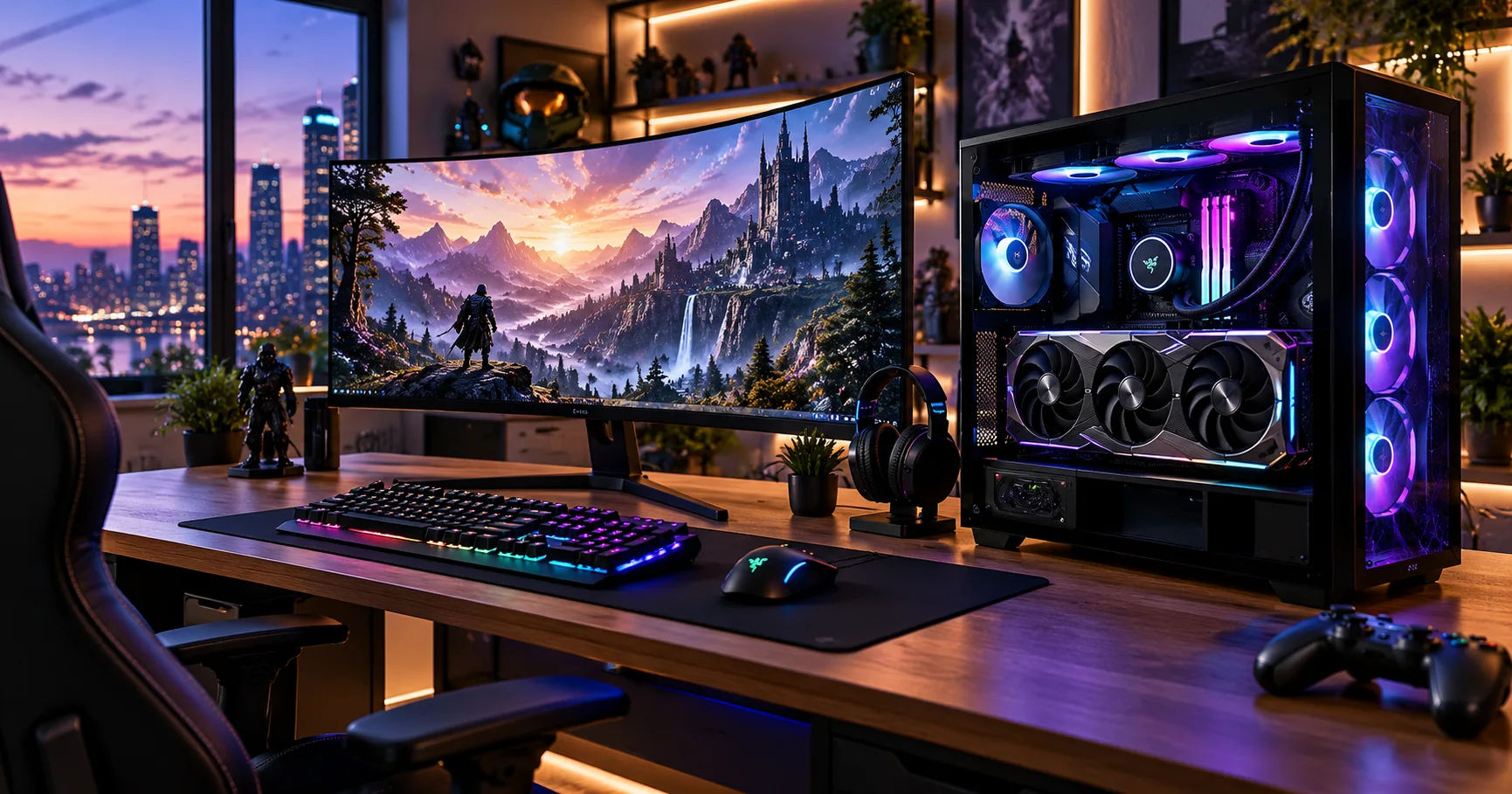 If you are researching rtx 5090 buy in dubai, you should consider more than the graphics card's price and availability. Dubai's hot climate, indoor cooling conditions, computer case design, and the specific graphics card model can all influence how hot the GPU becomes during demanding tasks.
The RTX 5090 is designed to operate under heavy workloads, but its temperature depends on how effectively heat moves away from the GPU and into the surrounding air. A well-designed system can keep temperatures under control, while poor ventilation or inadequate cooling can lead to higher temperatures, increased fan noise, and reduced performance in extreme conditions.
This comprehensive guide explains typical RTX 5090 temperatures, the effects of Dubai's climate, gaming and rendering heat levels, cooling solutions, warning signs, and the factors to consider before purchasing this powerful graphics card.
The RTX 5090's Temperature
The RTX 5090 uses a high-performance GPU architecture designed to handle demanding graphics workloads. Its performance makes it suitable for 4K gaming, ray tracing, AI applications, and professional content creation. However, these workloads require considerable electrical power, which is converted partly into heat.
The standard RTX 5090 has a total graphics power rating of approximately 575 watts. Actual power consumption varies depending on the workload, graphics card model, power limits, and system configuration.
This level of power consumption means that cooling is essential. The card's cooling system must transfer heat away from the GPU, memory, and other components without allowing temperatures to rise excessively.
What Is a Normal RTX 5090 Temperature?
Temperature depends on workload, room temperature, fan speed, and the particular card's cooler. The following ranges are useful general estimates rather than guaranteed specifications for every RTX 5090 model.
|
Usage scenario |
Approximate GPU temperature |
|---|---|
|
Idle or light desktop use |
30–45°C |
|
Everyday applications |
35–55°C |
|
Demanding gaming |
60–80°C |
|
Sustained heavy rendering |
65–85°C |
|
Hot environment or restricted airflow |
Potentially 80°C or higher |
These figures describe possible operating conditions, not fixed limits. Some models may operate below these ranges, while others may run warmer depending on their cooling designs and fan profiles.
A GPU temperature in the 70s Celsius during demanding gaming is not automatically a cause for concern. The more important question is whether the card maintains stable performance without excessive noise, unusual temperature spikes, or thermal throttling.
GPU Temperature Versus Hotspot Temperature
The main GPU temperature is not the only measurement worth monitoring. Many modern graphics cards also report a hotspot temperature, which represents the hottest measured area on the GPU die.
The hotspot reading is usually higher than the average GPU temperature because heat is not distributed evenly across the processor.
For example, a GPU temperature of 72°C alongside a hotspot temperature of 85°C may be reasonable under a heavy workload. However, an unusually large or growing difference between the readings can justify checking cooler contact, fan operation, and airflow.
Memory temperatures can also matter during demanding applications. Monitoring available temperature sensors gives you a more complete picture of how the graphics card behaves.
How Dubai's Climate Affects RTX 5090 Temperatures
Dubai's climate is an important consideration when planning a high-performance PC. Summer temperatures can be extremely high, and the temperature of the room where you use your computer directly affects how efficiently its cooling system works.
According to Visit Dubai, summer conditions can be particularly hot, with average temperatures varying by month. Indoor air conditioning is therefore especially important for electronics that generate substantial heat.
Why Ambient Temperature Matters
Ambient temperature is the temperature of the air surrounding your computer. A graphics card generally has an easier time cooling itself when the incoming air is cool.
Consider two gaming setups. The first operates in an air-conditioned room at 22°C, while the second runs in a room at 35°C without effective cooling. Even if both computers have identical hardware, the second system may experience higher GPU, memory, and internal case temperatures.
The difference is particularly important for a graphics card that can consume hundreds of watts during demanding workloads.
If you plan to research rtx 5090 buy in dubai, remember that the outdoor temperature is not the only factor. Your indoor environment, the placement of your PC, and the effectiveness of your air conditioning can matter just as much.
Can the RTX 5090 Overheat in Dubai?
Yes, overheating is possible if the cooling system cannot remove heat efficiently. However, Dubai's climate does not automatically make the RTX 5090 unsafe to use.
A properly cooled computer in an air-conditioned room can operate normally even during the hottest months. Problems become more likely when the PC is placed in a poorly ventilated enclosure, used in a hot room, or fitted with an unsuitable cooling system.
The graphics card may increase its fan speed to control temperatures. If it reaches its thermal limits, it can reduce its operating frequency to protect itself. This process is called thermal throttling.
The goal is not to make the GPU remain cold at all times. Instead, the goal is to maintain stable temperatures, reliable performance, and reasonable noise levels during extended use.
RTX 5090 Temperatures During Gaming and Rendering
Different workloads produce different amounts of heat. A game running at moderate settings may consume much less power than a demanding 4K title with advanced ray tracing enabled.
Professional rendering, AI processing, and other GPU-intensive applications can also maintain high utilization for extended periods.
Gaming at 1440p and 4K
Gaming resolution can affect the amount of work the graphics card performs. At 1440p, some games may place less demand on the GPU than they do at 4K, although the actual difference depends on graphics settings, frame rates, and the game engine.
At 4K resolution, especially with demanding ray tracing effects, the RTX 5090 can approach its rated power limit. This creates more heat that the cooler must dissipate.
Testing by Tom's Hardware found that the Founders Edition could stabilize around 80–81°C on the GPU core in demanding sustained gaming scenarios, with GDDR7 memory reaching approximately 96°C in some tests.
These results show why it is important to monitor both the GPU and its memory rather than relying on a single temperature reading.
Long Gaming Sessions
Playing for several hours does not necessarily damage the graphics card. Modern GPUs are designed for sustained workloads, provided they operate within their intended limits.
However, a computer that runs a demanding game for four hours will have more time to heat the air inside its case than one used for a short session.
In a Dubai summer, a room with weak air conditioning may become warmer as the computer releases heat into the surrounding environment.
To reduce this problem, keep the PC in an open, ventilated location, clean its air filters, and avoid placing it directly against a wall or inside a closed cabinet.
Video Editing, AI, and 3D Rendering
The RTX 5090 is also designed for professional workloads, including video editing, 3D rendering, and supported AI applications.
These tasks can keep the GPU busy for long periods, especially when rendering complex scenes or processing large datasets.
For example, a 3D artist may render a scene for an hour or longer. During this time, the graphics card needs to maintain a steady flow of cool air.
A good cooling setup should therefore be evaluated under sustained workloads, not only during a quick benchmark. Short tests may finish before the graphics card, memory, and case reach their highest stable temperatures.
Which RTX 5090 Cooling Design Is Best?
Different manufacturers sell RTX 5090 cards with their own cooling solutions, fan designs, heatsinks, and factory settings. These differences can affect operating temperatures, noise levels, and physical dimensions.
When evaluating a model, look beyond its advertised performance and RGB lighting.
Triple-Fan Air Cooling
Many custom RTX 5090 models use large heatsinks with three fans. These fans push air through metal fins that transfer heat away from the GPU and other components.
A well-designed triple-fan cooler can provide strong thermal performance without requiring a complicated liquid-cooling setup.
However, three fans do not guarantee lower temperatures. Heatsink size, fan quality, airflow restrictions, and the manufacturer's temperature profile all influence results.
Before purchasing, check independent reviews of the exact model you are considering.
Liquid Cooling
Some premium graphics card configurations use liquid cooling to transfer heat from the GPU to a radiator. The radiator then releases that heat into the surrounding air.
Liquid cooling can help manage sustained workloads and may offer attractive noise characteristics when properly configured.
Nevertheless, it is not automatically better for every buyer. Radiator placement, pump noise, installation complexity, maintenance, and case compatibility all matter.
In Dubai, the radiator must still receive sufficiently cool air. Liquid cooling moves heat efficiently, but it does not eliminate heat or make ambient temperature irrelevant.
Choosing Between Founders Edition and Custom Models
The Founders Edition uses a compact dual-slot cooling design, while partner cards may have larger coolers and different fan configurations.
Reviews demonstrate that the Founders Edition can deliver effective cooling, but results vary considerably with workload and test conditions. Some custom models may run cooler or quieter, although this should be verified through model-specific testing.
For a PC that will operate in Dubai throughout the year, compare sustained GPU temperatures, memory temperatures, noise levels, card dimensions, and warranty coverage before deciding.
How to Keep an RTX 5090 Cool in Dubai
A few practical improvements can make a significant difference to a high-power gaming PC.
1. Use Effective Air Conditioning
Maintaining a comfortable indoor temperature is one of the simplest ways to help your graphics card.
You do not need to turn your room into a refrigerator. A reasonably cool, stable environment helps the GPU cooler remove heat more efficiently.
If your PC room becomes hot during long gaming sessions, improving room ventilation or air conditioning may help more than increasing the graphics card's fan speed alone.
2. Choose a High-Airflow Case
Select a case with enough room for the graphics card and its cooling system. The case should support unobstructed intake and exhaust airflow.
A practical configuration includes front or bottom intake fans and rear or top exhaust fans, depending on the case design.
Check the card's length, width, thickness, and power connector clearance before buying. Large graphics cards can block nearby slots or restrict airflow when installed in compact cases.
3. Clean Dust Filters and Fans
Dust restricts airflow and can accumulate on heatsinks, fan blades, and filters. This becomes a problem when the computer operates for long periods.
Inspect your PC periodically and clean the filters when necessary. Before cleaning internal components, shut down the system and disconnect its power.
Use appropriate electronics-cleaning methods, and avoid opening the graphics card unless you have the necessary experience and a clear reason to do so.
4. Adjust the Fan Curve Carefully
A fan curve determines how quickly GPU fans spin as temperatures rise.
A more aggressive fan curve may reduce temperatures, but it can also increase noise. A quieter curve may allow somewhat higher temperatures while keeping the system more comfortable to use.
Use monitoring software to test changes gradually. Avoid settings that create unnecessary fan noise without delivering a meaningful thermal improvement.
5. Consider Undervolting or Power Limiting
Undervolting reduces the voltage used by the GPU under suitable operating conditions. Power limiting restricts the amount of power the card can draw.
Both approaches may reduce heat, depending on the settings and workload.
An RTX 5090 does not always need to run at its maximum power limit to provide excellent gaming performance. However, the benefits vary by game and application, so benchmark the results and check stability after changing settings.
Do not assume that every undervolt will work reliably. An unstable configuration can cause crashes or graphical errors.
Warning Signs That Your RTX 5090 Is Running Too Hot
Monitoring temperatures helps you identify potential problems before they affect performance or reliability.
Unexpected Performance Drops
If your game suddenly becomes slower after running smoothly for several minutes, excessive heat may be one possible explanation.
Thermal throttling can reduce GPU clock speeds when temperatures approach the card's thermal limits. However, performance drops can also result from driver problems, background applications, insufficient power, or CPU limitations.
Check temperatures, clock speeds, GPU utilization, and power consumption together before deciding that heat is responsible.
Excessive Fan Noise
Graphics card fans become louder when they work harder to remove heat. A sudden increase in fan noise may indicate a warmer room, blocked airflow, dust buildup, or an unexpected workload.
Some fan noise is normal during demanding gaming. However, grinding sounds, rattling, or fans that stop working unexpectedly deserve further investigation.
Unusual Crashes or Instability
Repeated crashes during demanding games can sometimes indicate thermal problems, but they are not proof of overheating.
Other possible causes include unstable overclocking, driver issues, insufficient power delivery, or defective hardware.
If crashes occur alongside unusually high temperatures, stop demanding workloads and investigate the cooling system. If you notice burning smells, visible connector damage, or signs of electrical overheating, shut down the computer and disconnect power when safe to do so. Have the system inspected by a qualified technician.
What to Check Before Buying an RTX 5090 in Dubai
When researching rtx 5090 buy in dubai, make temperature management part of your purchasing decision rather than treating it as an issue to solve later.
Consider these factors before spending money on the graphics card.
-
Cooling performance: Read reviews that include sustained gaming and memory temperature measurements.
-
Case compatibility: Confirm that the card fits comfortably and has enough room for airflow and power cables.
-
Power supply: NVIDIA recommends a 1,000-watt system power supply for the RTX 5090, although actual requirements depend on the complete system. Choose a quality unit with appropriate connections and sufficient capacity.
-
Warranty and support: Check the manufacturer's warranty terms, seller reputation, and local service arrangements.
-
Room cooling: Consider whether your gaming room remains comfortable during Dubai's hottest months.
-
Total system cost: Budget for the case, fans, power supply, and any cooling upgrades rather than spending everything on the graphics card.
These considerations are particularly important for first-time high-end PC builders. A well-balanced computer can deliver a better overall experience than a powerful GPU installed in a poorly ventilated system.
Conclusion
The RTX 5090 is an exceptionally powerful graphics card, but its performance comes with substantial heat output. With a rated graphics power of approximately 575 watts, it requires an effective cooling system, adequate power delivery, and a well-ventilated computer case.
For buyers considering rtx 5090 buy in dubai, the most important factor is the environment in which the graphics card will operate. Dubai's hot climate can make cooling more challenging, particularly in rooms without reliable air conditioning. Nevertheless, a properly designed system can handle demanding gaming, 4K ray tracing, professional rendering, and other intensive workloads.
Temperatures around 70–80°C during demanding gaming can be reasonable, depending on the graphics card model and test conditions. Memory and hotspot readings should also be monitored because they can be significantly higher than the main GPU temperature.
To achieve reliable performance, choose a model with a capable cooler, provide sufficient airflow, clean dust filters regularly, and consider power limiting if you want to reduce heat and noise. Check temperatures under sustained workloads rather than relying on short tests.
Ultimately, rtx 5090 buy in dubai should be a decision based on the complete PC setup, not just the graphics card's specifications. With sensible cooling, appropriate room conditions, and careful hardware selection, you can enjoy the RTX 5090's impressive capabilities without allowing excessive heat to become a persistent problem.
About The Author
